
In France, after the Second World War, the spread of modern stained glass continued even more in the context of the country's Reconstruction.
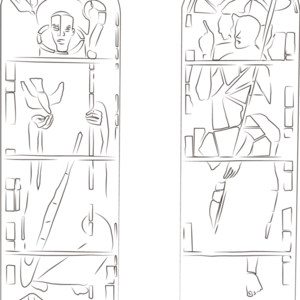
After 1945, the damage caused by the global conflict led to a new phase of reconstruction in the country, particularly in the western regions of France. Among the buildings affected by the bombings were numerous churches that needed to be renovated or rebuilt. Often, this also involved commissioning new stained glass windows from glass painters or, from then on, from contemporary artists, who sometimes displayed their sample panels in exhibitions and salons.
It is in this context that Gabriel Loire opened his stained glass workshop in 1946, near Chartres. To showcase his work, which notably includes the special creation of slab glass windows set in cement, he created exhibition panels, such as Christ in Majesty and Judas, dated 1950, which he displayed at his home, the Château de Lèves.
Similarly, Paul and Jacques Bony often exhibit display panels at Parisian salons. In his first year of activity, in 1944, Jacques Bony created a stained glass window depicting The Adoration of the Shepherds, which he exhibited at the Salon d'Automne of the Liberation. While his brother, Paul Bony, also had this habit, he regularly collaborated with contemporary artists such as Matisse, Rouault, or Braque, for whom he created stained glass windows. In 1954, he executed Braque's stained glass windows for the Saint-Dominique chapel in Varengeville-sur-Mer, Normandy. This collaboration also gave him the opportunity to create, in 1956, a personal work for the parish church of the same village, consisting of a large stained glass window of Saint Valery and Saint John the Baptist, which was unfortunately never installed.