
In 1918, the « Le Verre Français » brand was registered by the Schneider glassworks to create a more whimsical range than the high-end glassware of the Schneider line.
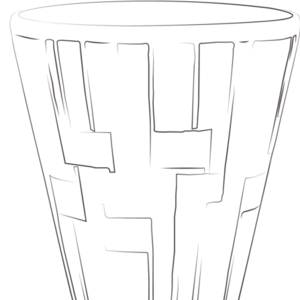
Despite the simplicity of the shapes and stylized designs of this second commercial line, the Le Verre Français brand quickly became a resounding success, particularly across the Atlantic. Customers appreciated both the boldness and modernity of the colors, as well as the contrast of the smooth, glossy patterns against the matte, acid-etched backgrounds.
While the range of colors used remained limited (seventeen shades were identified), over one hundred and eighty decorative patterns were recorded. These appeared indiscriminately on vases of varying shapes and in several colors, thus multiplying the models. Although the brand was profitable due to its widespread commercial distribution, the additional engraving of the patterns reduced its profit margin.
Initially identified by a tricolored berlingot (a small, round, round shape), then replaced by the signature "Le Verre Français" (The French Glass), the brand's objects began to display, from 1925 onward, the term "Charder," derived from the contraction of Charles Schneider. Toward the end of the 1920s, the pieces evolved toward more geometric shapes and designs.